
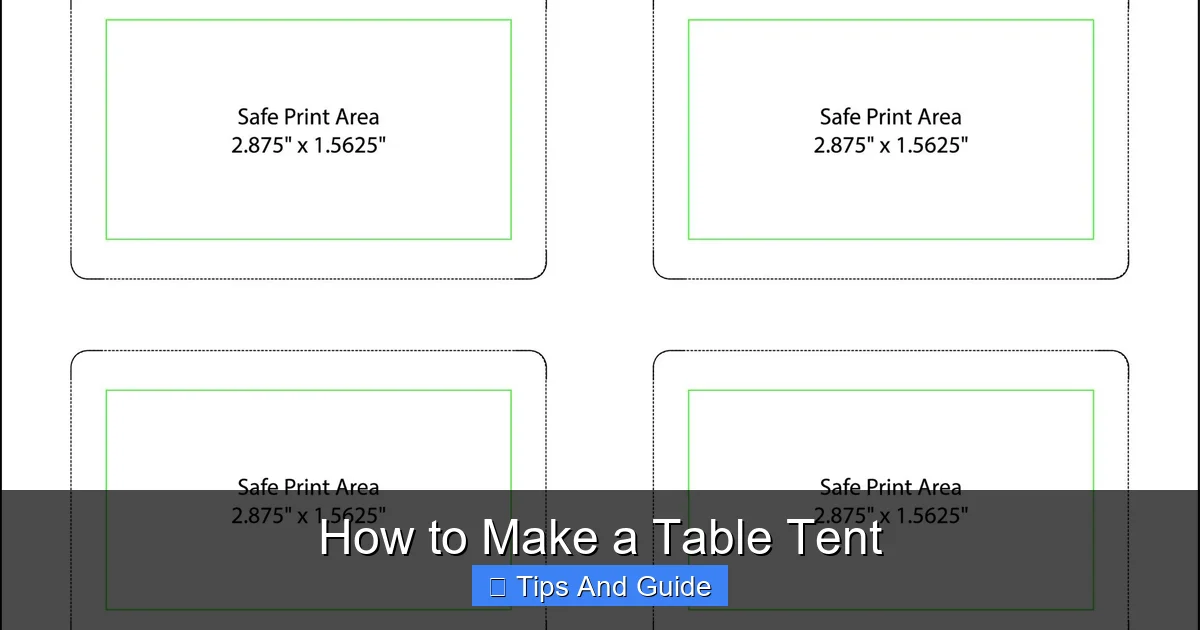
Creating a table tent is a fun and practical DIY project that can elevate your next event or business presentation. This comprehensive guide will walk you through the process, from choosing your materials to scoring and folding for a professional finish. With a few simple tools and a bit of creativity, you can design and make eye-catching table tents that effectively communicate your message. Get ready to add a personal touch to your displays!
# How to Make a Table Tent
Table tents are fantastic little display tools. They stand up on their own, making them perfect for restaurants, events, trade shows, or even just to leave on your desk. You can use them to highlight specials, announce upcoming events, provide information, or showcase your business. Making your own table tents is surprisingly easy and cost-effective! This guide will teach you everything you need to know to create your own custom table tents, from design to the final fold.
## Why Make Your Own Table Tents?
Before we dive into the how-to, let’s briefly touch on why you might want to make your own table tents.
* **Cost-Effective:** Buying pre-made table tents can add up, especially if you need many. DIY saves you money.
* **Customization:** You have complete control over the design, size, colors, and content. This is perfect for branding or specific event themes.
* **Creativity:** It’s a great outlet for your creativity. You can experiment with different papers, embellishments, and layouts.
* **Speed:** For last-minute needs, a quick DIY table tent can be a lifesaver.
## What You’ll Need
Gathering your supplies is the first step. You don’t need much, and most of it is probably already around your home or office.
* **Paper or Cardstock:** This is your main material. Choose something sturdy enough to stand on its own. Cardstock (around 65-110 lb or 176-300 gsm) is ideal. You can get it in various colors and finishes.
* **Ruler:** A metal ruler is best for cutting with a craft knife.
* **Pencil:** For marking your measurements and fold lines.
* **Craft Knife or Scissors:** A craft knife and cutting mat offer the most precision.
* **Cutting Mat (Optional but Recommended):** Protects your work surface if using a craft knife.
* **Scoring Tool:** This is crucial for crisp folds. You can use a bone folder, the dull edge of a butter knife, a ballpoint pen that has run out of ink, or a specialized scoring tool.
* **Printer (Optional):** If you want to print your design directly onto the cardstock.
* **Adhesive (Optional):** Double-sided tape, glue stick, or a few drops of craft glue if your design requires it.
## Step 1: Design Your Table Tent
This is where you get to be creative! Think about what you want your table tent to say and how you want it to look.
### Determine the Size and Shape
The most common table tent shape is a triangular prism. This means it has three main panels: two for displaying content and one that forms the base to keep it standing.
* **Standard Sizes:** A common size for the front display panel might be around 4 inches wide by 6 inches tall. This means your total paper needs to be about 12 inches wide (4 inches for the front, 4 inches for the back, and 4 inches for the base) and 6 inches tall.
* **Proportions:** The base panel needs to be wide enough to support the tent. Roughly, the width of the base panel should be about half the width of your display panels.
* **Consider Your Content:** Will you have text, images, or both? Make sure your design panels are large enough to accommodate everything clearly.
### Sketch Your Layout
Grab a piece of scrap paper and a pencil.
* **Panel 1 (Front):** This is what people will see first. Put your main message, logo, or image here.
* **Panel 2 (Back):** Use this for additional information, a call to action, contact details, or a complementary image.
* **Panel 3 (Base):** This is usually the shortest panel, designed to tuck under or attach to the other panels to create stability. You might want to add a small note here like “See reverse” or just leave it blank.
Think about the orientation. Do you want a portrait (taller than wide) or landscape (wider than tall) table tent? This will affect your measurements. For this guide, we’ll assume a standard portrait orientation.
### Example Design Dimensions (for a standard portrait tent)
Let’s say you want your front and back panels to be 4 inches wide and 6 inches tall.
* **Total Width:** You’ll need three sections of 4 inches each, totaling 12 inches.
* **Total Height:** This will be 6 inches.
So, you’ll be working with a rectangle that is 12 inches wide by 6 inches tall.
## Step 2: Prepare Your Material
Now it’s time to get your cardstock ready.
### Measure and Mark
Using your ruler and pencil, carefully measure and mark your paper according to your chosen dimensions.
* **For our example (12″ x 6″):**
* Draw a rectangle that is 12 inches by 6 inches.
* On the 12-inch side, make marks at 4 inches and 8 inches. These marks will represent the lines where your panels will fold.
* Draw straight lines from these marks across the 6-inch height. You should now have your 12″ x 6″ rectangle divided into three equal 4″ x 6″ sections.
### Score the Fold Lines
This is a critical step for a professional-looking table tent. Scoring creates a crease that allows the paper to fold cleanly and sharply without tearing or buckling.
* **Choose your tool:** Select your scoring tool (bone folder, dull knife edge, empty pen).
* **Align your ruler:** Place your ruler along the pencil lines you drew at the 4-inch and 8-inch marks.
* **Apply pressure:** Gently run your scoring tool along the ruler’s edge. You want to indent the paper, not cut it. Apply enough pressure to create a visible crease, but don’t tear through the cardstock.
* **Repeat:** Score both fold lines.
If you’re printing your design, it’s best to do that *before* scoring.
## Step 3: Cut Your Table Tent
Precision is key here.
### Cutting with a Craft Knife
* **Place on cutting mat:** Position your scored cardstock on a cutting mat.
* **Align ruler:** Place your metal ruler firmly along one of the outside edges of your 12″ x 6″ rectangle. Make sure the ruler’s edge is aligned with the very edge of the paper.
* **Cut carefully:** Using your craft knife, carefully cut along the ruler’s edge. Apply firm, steady pressure. Make one or two passes if needed, rather than trying to cut through in one go.
* **Repeat:** Cut along the other outside edge. You should now have a 4″ x 6″ panel with two scored lines down its length.
### Cutting with Scissors
If you don’t have a craft knife, you can use scissors, but it might be harder to get perfectly straight lines.
* **Mark clearly:** Ensure your pencil lines are very clear.
* **Cut slowly:** Follow your lines as precisely as possible. Try to keep your cuts as straight and steady as you can.
## Step 4: Fold and Assemble Your Table Tent
Now for the satisfying part – bringing your table tent to life!
### Folding Along the Scores
* **Gently fold:** Carefully fold the cardstock along the scored lines. The scores should make the folds much easier.
* **Crease firmly:** Once you have a fold, run your scoring tool (or even your fingernail) along the crease to make it sharp and permanent. You should now have a long, folded strip.
### Forming the Triangle
You have three panels: Panel 1 (front), Panel 2 (back), and Panel 3 (base).
* **Bring the edges together:** Stand the folded strip up. You’ll want to bring the outer edges of Panel 1 and Panel 2 together to form the triangular shape. Panel 3 (the base) will be the one that tucks underneath or attaches.
* **Consider your design:** How do you want Panel 3 to connect?
* **Tuck-in Method:** Often, Panel 3 is designed to be slightly shorter than Panels 1 and 2. You can then fold Panel 3 slightly inward and tuck it *under* the edge of Panel 2 (or Panel 1, depending on which way you fold). This creates a stable structure without any adhesive.
* **Adhesive Method:** If you want a super secure connection, or if your design doesn’t lend itself to tucking, you can use adhesive. Apply double-sided tape or a thin layer of glue to the edge of Panel 3. Then, press it firmly onto the back of Panel 1 or Panel 2.
* **Experiment with the base width:** If your tent feels wobbly, you might need to adjust the width of your base panel in your initial design. A wider base offers more stability.
### Ensuring Stability
* **Test the stand:** Once folded and assembled, place your table tent on a flat surface. Does it stand up straight without leaning too much?
* **Adjust folds:** If it’s leaning, check your folds. Are they crisp enough? Are the panels aligned correctly? Sometimes, a slight adjustment to the angle of the base panel can make a big difference.
## Step 5: Add Finishing Touches
Now, make your table tent even better!
### Printing Your Design
If you’re not drawing by hand, you’ll want to print your design.
* **Design Software:** Use graphic design software like Canva, Adobe Illustrator, or even Microsoft Word/Publisher to create your layout.
* **Print Settings:** Ensure your printer settings are correct for the size of your cardstock. Print a test page on regular paper first to check alignment.
* **Print on Cardstock:** Load your cardstock into the printer and print your design.
### Laminating
For extra durability and a professional sheen, consider laminating your table tent before folding.
* **Cold Laminating Sheets:** These are easy to use. Simply peel and stick the sheets onto both sides of your printed cardstock before cutting and folding.
* **Laminating Machine:** If you have a laminating machine, use that. This will add thickness, so be aware of that when scoring and folding. You might need to score a little harder.
### Embellishments
Get creative!
* **Stickers:** Add thematic stickers.
* **Ribbons:** Tie a ribbon around the base.
* **Die-cuts:** Cut out shapes from colored paper and glue them on.
* **Glitter:** For a festive touch.
## Troubleshooting Common Issues
Even with the best instructions, you might run into a few snags.
### My table tent won’t stand up straight.
* **Check your scores:** Are the fold lines crisp enough? Re-score them firmly.
* **Adjust the base:** The base panel (Panel 3) might need to be wider, or its angle needs adjustment.
* **Check your folds:** Ensure the angles are correct to form a stable triangle. Sometimes, a slight inward bend of the base can help.
### My folds are cracking or tearing.
* **Paper too thick:** If you’re using very heavy cardstock, scoring might not be enough. Consider using a lighter weight cardstock.
* **Scoring tool too sharp:** Make sure you’re using the *dull* edge of your scoring tool. You want to indent, not cut.
* **Folding too quickly:** Fold gently and deliberately along the scored line.
### My cuts aren’t straight.
* **Use a metal ruler:** A metal ruler provides a better guide for a craft knife.
* **Sharp blade:** Ensure your craft knife blade is sharp. A dull blade can tear the paper.
* **Practice:** Straight cutting takes practice. Don’t be discouraged if your first few aren’t perfect.
## Advanced Table Tent Ideas
Once you’ve mastered the basic triangular table tent, explore other possibilities!
* **Wedge Table Tents:** These have a flatter front and back panel, with the base being a wider wedge shape. They often look more modern.
* **Die-Cut Shapes:** Instead of a simple rectangle, you can design and cut out custom shapes for a truly unique look.
* **Multi-Panel Tents:** For more information, you could design a tent with more than three visible panels, though this increases complexity.
## Conclusion
Making your own table tents is a rewarding and practical skill. Whether you’re a small business owner looking for affordable marketing materials, an event planner adding personalized touches, or just someone who enjoys a good DIY project, this guide has given you the tools and knowledge to succeed. Remember to design thoughtfully, measure accurately, score precisely, and fold carefully. Your custom table tents will add a professional and creative flair to any setting. So, gather your supplies and start crafting your next statement piece!
If you’re looking for creative ways to enhance your camping setup, consider different types of tents. For instance, understanding the best pop-up tent for your needs can save you time and hassle. Also, don’t forget essentials like the best camping lights for tent to illuminate your space, much like how a table tent illuminates information.
- Design First: Sketch out your ideas and consider the purpose of your table tent to determine content and size.
- Material Matters: Cardstock or sturdy paper is ideal for durability and a professional look.
- Scoring is Key: Proper scoring allows for clean, crisp folds, making your table tent stand upright.
- Precision Cutting: Use a ruler and craft knife for accurate cuts and straight edges.
- Folding Techniques: Understand how to fold the scored lines to create the stable triangular shape.
- Finishing Touches: Add embellishments, lamination, or adhesive for a polished and functional table tent.
