
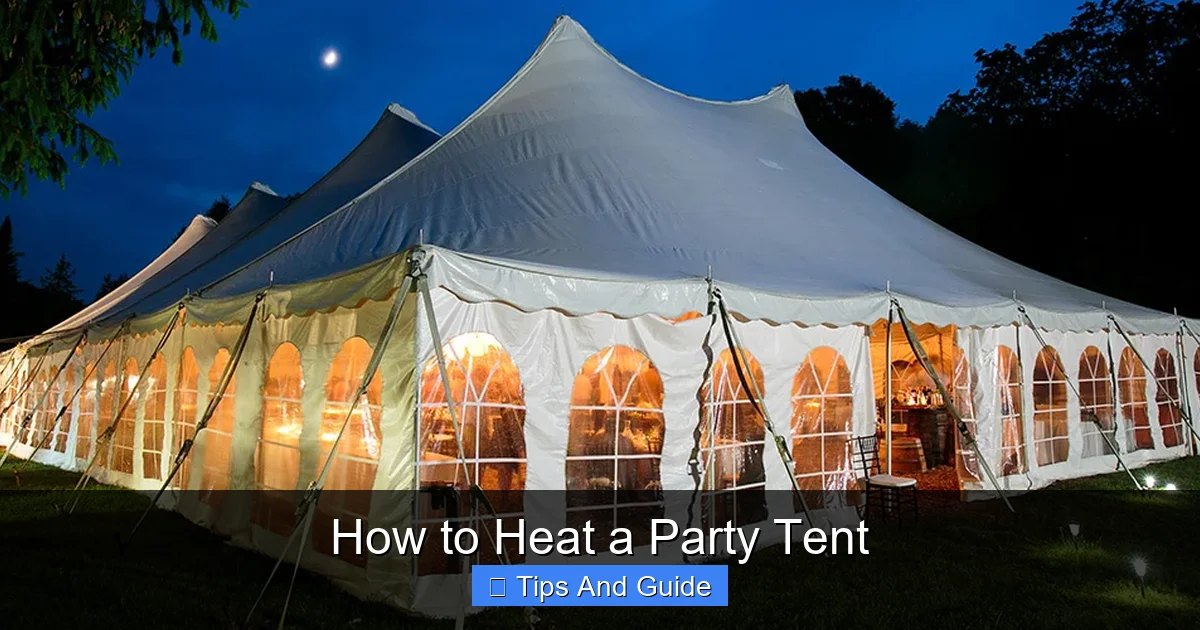
Planning a party in a tent requires careful consideration of temperature. This guide will help you understand the best ways to heat your party tent, ensuring a comfortable and enjoyable experience for all your guests. We’ll explore different heating options, discuss crucial safety measures, and offer practical tips for effective tent heating, so you can confidently host your event no matter the weather.
Hosting a party in a tent is a fantastic way to create a memorable event. Whether it’s a wedding reception, a birthday celebration, or a corporate gathering, tents offer a unique atmosphere. However, when the weather turns chilly, keeping your guests warm and comfortable becomes a top priority. This guide will walk you through everything you need to know about how to heat a party tent, ensuring your event is a success, regardless of the temperature outside. We’ll cover the best heating options, essential safety precautions, and practical tips to make your tent cozy and inviting.
## Understanding the Challenge: Why Tent Heating is Different
Party tents are often open structures or made from materials that don’t retain heat well. Unlike a solid building, a tent can lose heat rapidly through its walls, roof, and any gaps or openings. This means simply bringing a small electric heater might not be enough for a large space or a particularly cold day. You need a strategy that considers heat loss, distribution, and, most importantly, safety. If you’re using a tent for a specific purpose, like a farmers market or even a portable toilet enclosure, understanding its thermal properties is key.
## Step 1: Assess Your Tent and Needs
Before you even think about heaters, you need to assess your specific situation.
### Determine Tent Size and Type
The size of your tent is a major factor. A small pop-up canopy needs a different approach than a large, enclosed event tent.
* **Small Tents (e.g., 10×10, 10×20):** These are easier to heat but can overheat quickly if the wrong heater is used.
* **Medium to Large Tents (e.g., 20×30, 30×40 and larger):** These require more powerful heating solutions and careful consideration of heat distribution.
* **Enclosed vs. Open Tents:** Tents with walls and solid doors will hold heat much better than open-sided canopies. If your tent has roll-up sides, consider how much you’ll keep them down.
### Consider the Outside Temperature and Wind
How cold is it outside? Is it windy?
* **Mild Chill:** A smaller electric heater might suffice.
* **Freezing Temperatures:** You’ll need a more robust heating system.
* **Windy Conditions:** Wind will significantly increase heat loss, requiring a more powerful heater and potentially measures to block drafts. If wind is a major concern, consider a tent designed for windy conditions.
### Evaluate Power Availability
Do you have access to electricity? What kind of power is available?
* **Standard Outlets:** Most residential and many commercial spaces have 15-amp or 20-amp outlets. Electric heaters draw a lot of power, so you may be limited in how many you can use or their wattage.
* **Generator:** If you’re in a remote location, you’ll need a generator. Ensure it’s powerful enough for your heater and any other electrical needs.
* **No Power:** If electricity is not an option, you’ll need to rely on fuel-burning heaters (propane, kerosene), which come with stricter safety requirements.
## Step 2: Choosing the Right Heater
There are several types of heaters commonly used for party tents, each with its own advantages and disadvantages.
### Electric Heaters
Electric heaters are a popular choice because they are generally safe, clean-burning, and easy to use.
* **Types:**
* **Ceramic Heaters:** These use a ceramic element to heat air, which is then circulated by a fan. They are good for small to medium spaces.
* **Infrared Heaters (Radiant Heaters):** These heat objects and people directly, rather than the air. They are effective in open or drafty spaces because the heat isn’t lost as easily to the air. They are silent and don’t blow air, which can be a plus.
* **Fan Heaters (Convection Heaters):** These use a heating element and a fan to blow warm air into the space. They heat the air quickly but can be noisy.
* **Pros:** Safe, no fumes, easy to set up, readily available.
* **Cons:** Can be power-hungry. A single, high-wattage heater might trip a breaker if you only have access to standard outlets. Limited effectiveness in very large or extremely cold, drafty tents.
* **Recommendation:** Ideal for smaller tents, enclosed tents, or for providing supplemental heat in larger spaces. Look for models with thermostats to regulate temperature. You might need multiple units for larger tents. If you’re looking for a pop-up tent heater, electric options are often the safest bet for ease of use.
### Propane Heaters
Propane heaters are powerful and can heat large spaces effectively, making them a popular choice for larger tents or colder weather.
* **Types:**
* **Radiant Propane Heaters:** These typically have a ceramic or metal emitter that glows red hot, radiating heat. They often have a propane tank connected directly.
* **Forced-Air Propane Heaters (Salamander Heaters):** These are industrial-style heaters that use a fan to blow heated air produced by burning propane. They are very powerful but also quite noisy.
* **Pros:** Powerful, can heat large areas, not dependent on electricity (though some models have electric ignition or fans).
* **Cons:** **Require excellent ventilation** due to carbon monoxide production. Propane tanks take up space and need to be managed. Can produce a noticeable odor if not burning cleanly. Higher risk of fire if not used correctly.
* **Recommendation:** Best for larger, well-ventilated tents when electricity is not available or insufficient. **CRITICAL: Carbon monoxide detectors are an absolute must when using propane heaters.** Ensure the heater is designed for outdoor or well-ventilated indoor use.
### Kerosene Heaters
Kerosene heaters are another fuel-burning option, similar to propane heaters in terms of power and ventilation needs.
* **Pros:** Powerful, can heat large areas, often more affordable than propane heaters.
* **Cons:** **Require excellent ventilation** due to carbon monoxide. Kerosene can have a strong odor. Fuel needs to be stored and handled safely. Higher fire risk.
* **Recommendation:** Similar to propane, best for larger, well-ventilated tents. **CRITICAL: Carbon monoxide detectors are essential.**
### Direct-Fired Heaters (e.g., Natural Gas)
These are less common for typical party tents but are sometimes used for very large industrial or agricultural applications. They burn fuel directly into the heated space.
* **Pros:** Extremely powerful.
* **Cons:** **Extremely high risk** of carbon monoxide buildup. Require professional installation and ventilation. Generally not suitable or safe for temporary event tents.
## Step 3: Safety First – Critical Precautions
Heating a tent is not without risks, and safety should be your absolute top priority.
### Ventilation is Non-Negotiable
* **Carbon Monoxide (CO):** Fuel-burning heaters (propane, kerosene) produce carbon monoxide, an odorless, colorless, and deadly gas. Even electric heaters can pose a fire risk if they malfunction.
* **Solution:** Always ensure adequate ventilation. This means allowing fresh air to circulate. For fuel-burning heaters, this might mean leaving an opening in the tent or ensuring doors are at least partially open. For electric heaters, while CO isn’t a direct issue, good airflow prevents overheating and helps distribute heat.
* **Carbon Monoxide Detectors:** **This is the single most important safety measure when using fuel-burning heaters.** Install battery-operated carbon monoxide detectors inside the tent. Test them regularly and ensure they are placed at breathing level. If a detector alarms, evacuate the tent immediately and call for help.
### Fire Prevention
* **Clearance:** Keep heaters a safe distance from all tent walls, ceilings, furniture, decorations, and anything flammable. Check the heater’s manual for specific clearance recommendations. As a general rule, aim for at least 3 feet.
* **Stable Surface:** Place heaters on a stable, level surface where they won’t be easily knocked over.
* **Guards and Shields:** Some heaters come with protective guards. Use them.
* **No Flammable Materials Nearby:** Never store fuel, aerosols, or any flammable materials inside or near the heated tent.
* **Supervision:** Never leave a running heater unattended, especially if children or pets are present.
### Electrical Safety
* **Check Cords:** Ensure all extension cords and power cords are in good condition, free from damage, and rated for outdoor use if necessary.
* **Avoid Overloading Circuits:** Do not plug too many high-wattage appliances into a single circuit. If using a generator, ensure it has sufficient capacity.
* **GFCI Protection:** Use Ground Fault Circuit Interrupter (GFCI) outlets or extension cords, especially if there’s any chance of moisture.
### Fuel Handling (for Propane/Kerosene)
* **Storage:** Store fuel tanks upright in a well-ventilated area, away from heat sources and ignition points.
* **Connections:** Ensure all connections on propane tanks are secure and leak-free.
* **Refueling:** Never refuel a heater while it is hot or in operation. Do this in a well-ventilated outdoor area.
## Step 4: Setting Up and Operating Your Heater
Once you’ve chosen your heater and understood the safety rules, it’s time to set it up.
### Placement for Optimal Heat Distribution
* **Central Location (with caveats):** Placing a heater in the center of the tent can help distribute heat evenly, but this may not always be practical or safe depending on the heater type and tent layout.
* **Away from Walls:** As mentioned, always maintain safe clearance from tent walls.
* **Near High-Traffic Areas:** Position heaters where guests will benefit most, but not so close they are a hazard.
* **Consider Airflow:** If using a fan heater, direct the airflow towards the main gathering areas. If using a radiant heater, aim it towards where people will be sitting or standing.
### Managing Temperature
* **Thermostat Control:** Heaters with built-in thermostats are invaluable. They allow you to set a desired temperature and will cycle on and off to maintain it, preventing overheating and saving energy.
* **Manual Adjustment:** If your heater doesn’t have a thermostat, you’ll need to manually turn it on and off to regulate the temperature. This requires more attention.
### Sealing Drafts
* **Zip Up Sides:** If your tent has roll-up sides or doors, keep them zipped down as much as possible to trap heat.
* **Weighting Edges:** For open-sided tents, you might consider using sandbags or weights along the bottom edges to help reduce drafts from underneath.
* **Temporary Barriers:** In severe conditions, you might use temporary, non-flammable barriers to block wind from entering specific openings.
### Running the Heater
* **Pre-heating:** Turn on the heater about 30-60 minutes before guests arrive to pre-warm the space.
* **Monitoring:** Regularly check the temperature and adjust the heater as needed.
* **During the Event:** Continue to monitor the heater and the tent environment. Ensure CO detectors are functioning.
## Step 5: Troubleshooting Common Issues
Even with careful planning, you might encounter problems.
### Problem: The tent isn’t getting warm enough.
* **Possible Causes:** Heater is too small for the tent size, significant heat loss due to drafts or poor insulation, outside temperature is extreme, heater is malfunctioning.
* **Solutions:**
* **Increase Heater Power:** Use a more powerful heater or add a second heater (ensuring electrical circuits can handle the load).
* **Improve Insulation:** Seal drafts more effectively. Consider adding temporary wall coverings (e.g., heavy blankets, insulated tarps) if safe to do so.
* **Check Heater Output:** Ensure the heater is functioning correctly and not obstructed.
### Problem: The tent is getting too hot.
* **Possible Causes:** Heater is too powerful, thermostat is set too high, not enough ventilation, outdoor temperature is unexpectedly warm.
* **Solutions:**
* **Reduce Heater Setting:** Turn down the thermostat or manually lower the heat output.
* **Increase Ventilation:** Open up tent sides or doors slightly to allow some heat to escape.
* **Turn Off Heater:** If the temperature is comfortable without the heater, turn it off.
### Problem: A carbon monoxide detector is alarming.
* **Immediate Action:** **EVACUATE THE TENT IMMEDIATELY.** Do not attempt to turn off the heater or retrieve belongings. Get everyone to fresh air. Call emergency services (fire department).
* **After Evacuation:** Once safe and cleared by emergency personnel, investigate the heater and ventilation. Never use a fuel-burning heater again until the cause of the CO alarm is identified and rectified.
### Problem: Electrical breaker keeps tripping.
* **Possible Cause:** Overloaded electrical circuit.
* **Solutions:**
* **Reduce Load:** Unplug other high-wattage appliances from the same circuit.
* **Use Separate Circuits:** Connect heaters to different circuits if available.
* **Use a Lower Wattage Heater:** Opt for a less powerful electric heater.
* **Check Wiring:** If the problem persists with a single heater, there might be an issue with the wiring or the breaker itself.
## Conclusion
Heating a party tent is entirely achievable with the right approach. By carefully assessing your tent, choosing an appropriate heater, and, most importantly, prioritizing safety with proper ventilation and fire prevention, you can create a warm, inviting, and memorable atmosphere for your guests. Remember that a little preparation goes a long way in ensuring your tented event is a comfortable success, no matter how cold the weather. Always err on the side of caution when dealing with heating equipment, and never compromise on safety for the sake of warmth.
Key Takeaways
- Understand Tent Insulation: Party tents, especially those without walls or made of thin materials, lose heat quickly. Proper insulation and sealing drafts are crucial.
- Choose the Right Heater Type: Different heaters suit different needs. Electric, propane, and forced-air heaters are common options, each with pros and cons regarding safety, cost, and heat output.
- Prioritize Safety Above All: Tent heating carries risks. Always ensure proper ventilation, keep flammable materials away from heaters, and have a working carbon monoxide detector.
- Proper Heater Placement is Key: Position your chosen heater to maximize warmth distribution without creating fire hazards or being too close to guests.
- Consider Tent Size and Environment: The size of your tent and the outside temperature will dictate the type and wattage of the heater you need. Larger tents in colder weather require more powerful solutions.
- Don’t Forget Ventilation: Even with a heater, adequate ventilation is essential to prevent the buildup of dangerous gases like carbon monoxide and to manage humidity.
