
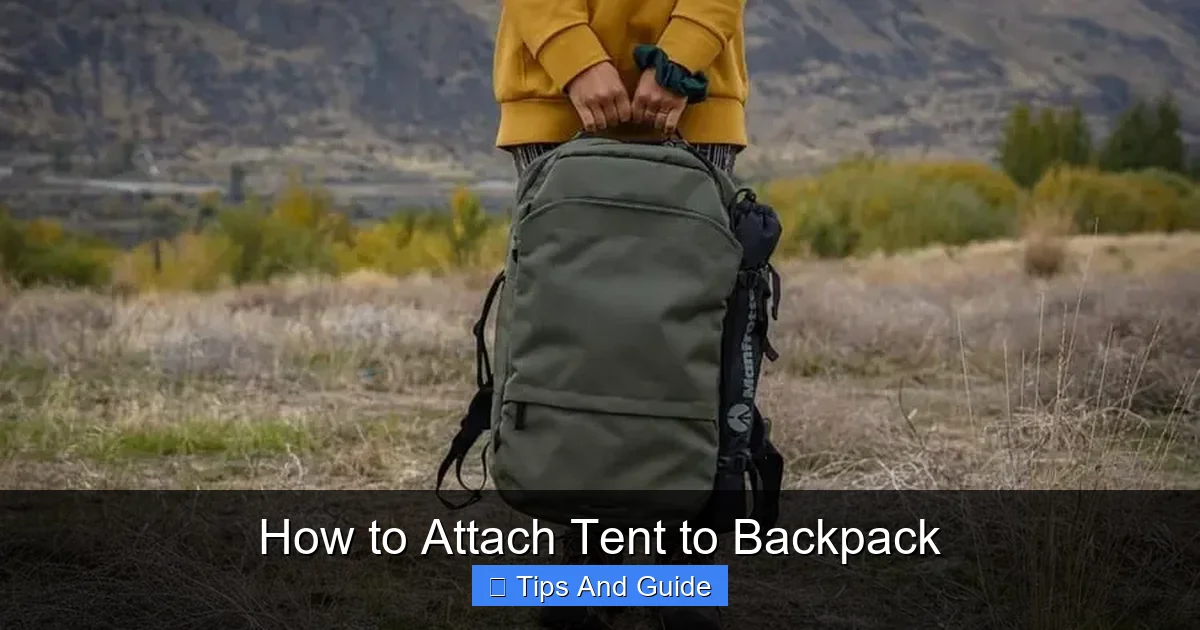
Carrying your tent efficiently is crucial for any outdoor excursion. This guide provides step-by-step instructions on how to securely and comfortably attach your tent to your backpack, ensuring it doesn’t shift or become a nuisance. Learn different methods for various tent types and backpack designs, so you’re ready for any adventure.
Embarking on a camping trip, whether it’s a weekend getaway or a multi-day backpacking expedition, always comes with the exciting challenge of packing. One of the most bulky items in any camper’s arsenal is the tent. Figuring out how to attach your tent to your backpack in a way that’s secure, balanced, and doesn’t make your trek miserable is a skill every outdoor enthusiast needs to master. This guide will walk you through the best practices, from preparing your tent to choosing the right spot on your pack, ensuring your tent travels safely and comfortably with you.
Getting your tent from point A to point B without it becoming a cumbersome burden is an art form. A poorly packed tent can lead to an unbalanced load, chafing, and general discomfort, turning a dream hike into a slog. But with the right knowledge and techniques, you can transform that bulky shelter into a manageable part of your hiking load. Let’s dive into how to attach your tent to your backpack effectively.
## Preparing Your Tent for Attachment
Before you even think about strapping your tent to your backpack, it needs to be properly prepared. This step is crucial for minimizing its size and making it easier to secure.
### Packing Your Tent Components
Most tents come with a main tent bag, a bag for poles, and a bag for stakes. For backpacking, especially, it’s beneficial to consolidate these as much as possible.
#### Stuffing the Tent Body and Fly
Instead of neatly folding your tent, which can be time-consuming and often results in a larger, less compressible shape, stuffing is the way to go for many backpackers.
* **Stuff the tent body and fly:** Take the main tent body and rainfly and stuff them into their designated stuff sack or a compression sack. Don’t worry about perfect folds; aim to fill the sack completely and evenly.
* **Use a compression sack:** If your tent came with a compression sack, or if you have one, use it. These sacks have straps that allow you to significantly reduce the volume of your tent. This is particularly helpful for larger tents or when space is at a premium.
* **Shake it out:** Ensure there are no major air pockets. Give the sack a good shake to settle the fabric.
#### Managing Poles and Stakes
The tent poles and stakes are often rigid and can be difficult to pack neatly.
* **Tent poles:** Many backpacking tents have poles that collapse into sections. Keep them together. Some packs have dedicated external pockets or sleeves for poles. If yours doesn’t, you can often slide them into a water bottle pocket or a side pocket and secure them with a compression strap. Alternatively, some people choose to place them alongside the tent in its stuff sack if the material is durable enough.
* **Stakes:** Stakes are sharp and can be a nuisance. Keep them in their bag. If the bag is small, you can often tuck it into a side pocket or a hip belt pocket. For larger stake bags, consider securing them with a strap. Some backpackers opt for lighter-weight stakes that are less bulky.
## Choosing the Right Location on Your Backpack
Where you place your tent on your backpack is just as important as how you secure it. The goal is to maintain balance and prevent the tent from shifting or snagging.
### Common Attachment Points and Strategies
Most backpacks are designed with external features to help you carry bulky items like tents.
#### The Top of the Pack
This is perhaps the most common place to attach a tent.
* **Benefits:** It’s easily accessible, and if packed correctly, it doesn’t significantly affect your center of gravity.
* **How to do it:**
* **Method 1: Strapping it down:** Place the stuffed tent bag on top of your other gear, typically over the main compartment lid or the brain of the backpack. Use the backpack’s compression straps or dedicated gear straps to cinch it down firmly. Ensure the straps go *over* the tent bag and loop through the pack’s anchor points.
* **Method 2: Using the lid:** Some backpack lids are designed to be unzipped and have an internal space for gear. You can also strap the tent directly to the underside of some lids, though this is less common and can make accessing the lid compartment tricky.
#### The Bottom of the Pack
This is another popular spot, particularly for lighter tents or when the top is already occupied.
* **Benefits:** It can help distribute weight lower, which some hikers find more stable.
* **How to do it:**
* **Strapping it down:** Most backpacks have straps at the very bottom. You can slide the tent bag underneath these straps and tighten them securely. Ensure the tent is positioned so it doesn’t drag on the ground when you set your pack down.
* **Considerations:** Be mindful that if the tent is heavy, placing it at the bottom can make lifting and carrying the pack feel heavier.
#### The Sides of the Pack
Attaching a tent to the side can be useful for longer, slimmer tents or when you need quick access.
* **Benefits:** Keeps the top and bottom free for other gear.
* **How to do it:**
* **Water bottle pockets:** If your tent bag is relatively narrow and long, it might fit snugly into a side water bottle pocket. You can then use the side compression straps to secure it further.
* **Using compression straps:** Thread the side compression straps around the tent bag. Tighten them so the tent is held firmly against the side of your pack. Make sure it doesn’t stick out too far, as this can cause it to snag on branches.
#### The Front of the Pack (Less Common)
While not as typical, some backpack designs or specific situations might call for attaching a tent to the front.
* **Benefits:** Can free up other attachment points.
* **How to do it:**
* **Daisy chains and loops:** Many backpacks have “daisy chains” (vertical webbing loops) or other attachment points on the front. You can use straps to secure the tent bag to these.
* **Considerations:** Attaching to the front can significantly alter your balance and make it harder to navigate through tight spaces. It’s generally best avoided unless absolutely necessary.
## Securing the Tent Properly
Once you’ve chosen a location, the next critical step is to secure the tent so it doesn’t move. A shifting tent is a major cause of discomfort and can throw off your balance.
### Tightening Straps and Checking for Security
This is where the real work of a secure attachment happens.
#### Using Compression Straps
Most backpacks come equipped with compression straps on the sides and sometimes the top.
* **Thread and tighten:** Feed the straps through the buckles and pull them tight. The goal is to make the tent bag feel like an integrated part of your backpack, not an appendage.
* **Multiple straps:** If possible, use more than one strap to secure the tent. This distributes the pressure and provides a more stable hold.
* **Don’t overtighten:** While you want it secure, avoid overtightening to the point where you damage the tent bag or the backpack itself.
#### Utilizing Lashing Straps and Bungees
Some backpacks have dedicated lashing points or come with extra straps. Bungee cords can also be useful, but use them with caution as they can sometimes loosen unexpectedly.
* **Dedicated straps:** Use any straps provided for gear attachment. These are usually reinforced and designed for this purpose.
* **Bungee cords:** If using bungee cords, ensure they are strong and that the hooks are securely fastened to anchor points. Always double-check their tension.
### Balancing the Load
The weight and placement of your tent will affect your pack’s balance.
* **Keep it centered:** Whether on top, bottom, or side, try to keep the tent as centered as possible on your backpack.
* **Even weight distribution:** If you have other bulky items, try to balance the weight of the tent with other gear on the opposite side or within the pack. For instance, if the tent is on top, ensure heavier items are lower down inside the pack to maintain a lower center of gravity.
* **Test the feel:** Once attached, lift your backpack and walk around a bit. Does it feel balanced? Does the tent dig into your back or shoulders? Make adjustments as needed.
## Tips for Different Tent Types
While the general principles apply, specific tent types might require slight variations in how you attach them.
### Lightweight Backpacking Tents
These are often designed to be compressible and are usually easier to pack.
* **Stuffing is key:** Because they are designed for compressibility, stuffing them into their sacks and using compression straps is usually very effective.
* **External pockets:** Many backpacking tents, when stuffed, can fit into the side pockets of a good quality backpack, allowing you to use the main straps for other gear.
### Larger Camping Tents (e.g., Family Tents)
These are significantly bulkier and heavier.
* **Consider splitting the load:** If you’re camping with others, divide the tent components. One person might carry the tent body, another the poles and fly.
* **Dedicated gear carriers:** For car camping, where the tent is less likely to be carried long distances on a backpack, you might use a dedicated cargo carrier or pack it directly into the car.
* **Strapping to the outside:** For shorter hikes to a campsite, you might strap the entire tent bag to the bottom or top of a very robust pack, using multiple heavy-duty straps. You may even consider using straps that wrap *around* the entire pack for extra security.
### Pop-Up Tents
These tents, while convenient for setup, can be awkward to pack.
* **Follow manufacturer instructions:** Pop-up tents often have specific folding and packing instructions. These are crucial because improper folding can damage the tent’s frame.
* **Secure the shape:** Once folded into their circular or disc shape, they can be quite stiff. You might need to use straps to hold them flat against the back of your pack or use a larger stuff sack and then secure that. Some pop-up tents are designed with straps to attach them to larger bags. If you’re looking for one of the best pop-up tents, consider their packed size.
## Weather Considerations
Protecting your tent from the elements, both during transport and at the campsite, is important.
### Keeping Your Tent Dry
If there’s a chance of rain, you’ll want to protect your tent and the rest of your gear.
* **Waterproof stuff sack:** Place your tent bag inside a waterproof stuff sack or a dry bag. This adds an extra layer of protection.
* **Backpack rain cover:** Use a rain cover for your backpack. While this protects the exterior, if the tent is strapped on the outside, it might still get wet. The dry bag inside is your best bet.
* **Inside the pack (if possible):** If your tent is small and you have space, consider packing it inside your backpack, perhaps in a garbage bag liner, to guarantee it stays dry. This is usually only feasible for ultralight or very small tents.
## Troubleshooting Common Issues
Even with the best intentions, you might run into problems.
### Tent Shifting or Loosening
* **Problem:** Straps loosen over time, and the tent bag starts to sway.
* **Solution:** Stop and retighten your straps. Consider using straps with cam locks or double-buckling for extra security. Ensure you are using the backpack’s intended anchor points.
### Awkward Balance or Discomfort
* **Problem:** The tent placement is making your pack feel off-balance or is causing pressure points.
* **Solution:** Reposition the tent. Try a different location (top, bottom, side). Adjust the contents inside your backpack to compensate for the tent’s weight and position. Ensure the tent isn’t digging into your back.
### Tent Snagging on Branches
* **Problem:** The tent sticks out too far from the pack and catches on foliage.
* **Solution:** Compress the tent bag further. Reposition it to be closer to your body or further up/down your pack. Ensure side attachments are snug. For very bulky tents, this might mean reconsidering if it’s the best type of tent for that particular trail.
## Conclusion
Attaching your tent to your backpack might seem like a minor detail, but mastering this skill significantly enhances your comfort and enjoyment on the trail. By properly preparing your tent, choosing the right attachment location, and securing it tightly, you ensure a balanced load and a hassle-free journey. Remember to always consider the type of tent you have and the weather conditions. With a little practice, you’ll find the perfect way to carry your home away from home, leaving you free to focus on the incredible scenery and the adventure ahead. Happy trails!
Key Takeaways
- Properly compress and pack your tent: Always stuff your tent into its compression sack to minimize its volume before attaching it to your backpack.
- Utilize external attachment points: Most backpacks have straps, loops, and daisy chains specifically designed for securing gear like tents.
- Distribute weight evenly: Place the tent in a location on your backpack that maintains balance and doesn’t create an awkward center of gravity.
- Secure tightly to prevent shifting: Loose gear can throw off your balance and cause discomfort. Ensure your tent is cinched down firmly.
- Consider weather protection: If rain is a possibility, consider placing your tent in a waterproof bag or using a rain cover to keep your other gear dry.
- Choose the right method for your tent type: Different tent designs and sizes may require slightly different attachment strategies.
