
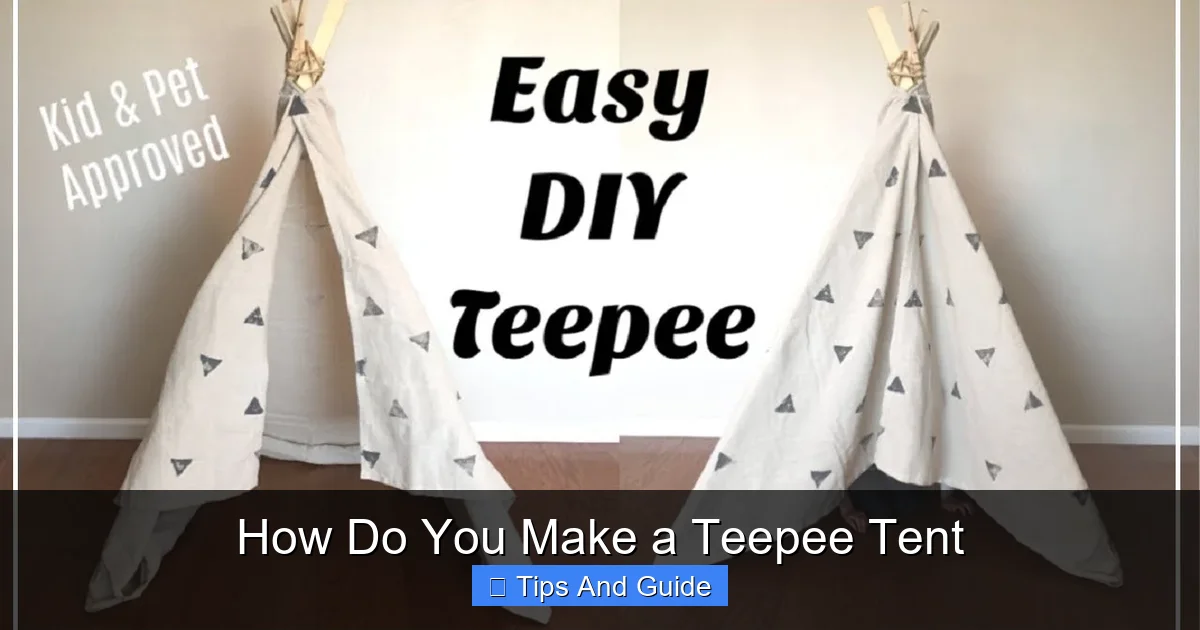
Discover how to build your own teepee tent with this easy-to-follow guide. We cover everything from gathering materials to the final assembly, perfect for camping adventures or backyard play. Create a unique shelter that’s both functional and fun.
Are you dreaming of a rustic camping trip or looking for a unique play space for the kids? Building your own teepee tent might be just what you need! It’s a rewarding project that allows for customization and a connection to a traditional shelter design. This guide will walk you through every step, from selecting materials to the final construction. You’ll learn how to make a teepee tent that’s both functional and a fantastic addition to your outdoor adventures.
### What is a Teepee Tent?
A teepee, also spelled tipi, is a conical tent traditionally made by indigenous peoples of the Great Plains in North America. It’s characterized by its distinctive shape, formed by leaning poles against each other and covering them with animal hides or canvas. Teepees are known for their stability, wind resistance, and ability to be erected and dismantled quickly. Modern teepee tents often adapt this design for camping or recreational use.
### Why Build Your Own Teepee Tent?
Making your own teepee offers several advantages:
* **Customization:** You can choose the size, fabric, and features to perfectly suit your needs.
* **Cost-Effectiveness:** Building it yourself can be more affordable than buying a pre-made teepee.
* **Sense of Accomplishment:** There’s a great feeling of satisfaction in creating something with your own hands.
* **Unique Design:** Stand out from the crowd with a handmade shelter.
* **Educational Value:** It’s a great project to do with children, teaching them about construction and traditional shelters.
Ready to get started? Let’s dive into the process!
## Step 1: Planning Your Teepee
Before you start cutting and tying, a little planning goes a long way.
### Determine the Size
Think about how you’ll use your teepee. Will it be for sleeping a few people? A playhouse? A shaded area for gatherings?
* **Small Teepee (e.g., 6-8 feet tall):** Good for a couple of people or a small playhouse.
* **Medium Teepee (e.g., 10-12 feet tall):** Comfortable for 2-4 people.
* **Large Teepee (e.g., 14-18 feet tall):** Suitable for families or larger gatherings.
The height will influence the length of your poles and the amount of fabric needed.
### Choose Your Location
Consider where you’ll set up your teepee. For camping, a relatively flat, well-drained spot is ideal. For a backyard teepee, ensure there’s enough space and that it’s away from any hazards.
### Sketch Your Design
A simple sketch can help visualize the finished product and identify any potential challenges. Note the number of poles, the fabric shape, and how you’ll secure it.
## Step 2: Gathering Your Materials
This is where your vision starts to become tangible.
### Poles
* **Number:** For a stable teepee, you’ll need at least three poles. Four poles (forming a square base) can offer more stability, especially for larger structures.
* **Type:**
* **Natural Poles:** Straight, strong, and dry branches from trees like pine, fir, or lodgepole pine are traditional. They should be at least 2-3 inches in diameter at the base and free of rot or major knots. You’ll need to find ones that are all roughly the same length and straightness.
* **Dowel Rods/Wooden Poles:** For a more refined look or if natural poles aren’t available, you can purchase wooden dowels or poles from a lumber yard. Ensure they are strong enough for the size of your teepee. For very large teepees, consider thicker, sturdy lumber.
* **Length:** The pole length should be about twice the desired height of your teepee. For example, for a 10-foot tall teepee, you’ll need poles around 20 feet long. They will angle inwards, so this extra length is crucial.
### Fabric
* **Type:**
* **Canvas:** Heavy-duty canvas (10-12 oz.) is the most traditional and durable choice. It’s breathable and provides good weather protection. You can buy it in large rolls.
* **Ripstop Nylon/Polyester:** Lighter and more waterproof than canvas, but can be less breathable. Good for a more modern, lightweight teepee.
* **Tarpaulin:** A very economical and waterproof option, but can be noisy in the wind and less breathable.
* **Amount:** This depends heavily on your teepee’s size and design. For a typical 10-foot tall teepee, you might need a piece of fabric that is roughly 15-20 feet wide and 25-30 feet long when unrolled. It’s always better to have a little extra fabric than not enough.
* **Color:** Choose a color that suits your aesthetic. Natural, earth tones are classic for teepees.
### Rope or Cordage
* **Type:** Strong, weather-resistant rope like nylon or paracord is essential. You’ll need a good amount for lashing the poles and for tying the fabric.
* **Length:** At least 50-100 feet, depending on the size of your teepee and how you plan to secure the fabric.
### Fasteners and Hardware
* **Grommets (optional):** If you want to attach the fabric securely and neatly, consider using grommets along the edges of your fabric. You’ll need a grommet kit and a hammer.
* **Tent Stakes:** For securing the base of your teepee to the ground. Heavy-duty stakes are recommended.
* **D-rings or Loops (optional):** You can attach these to the fabric for easier tying to the poles.
### Tools
* **Measuring Tape:** For accurate measurements.
* **Saw:** To trim poles if necessary.
* **Knife or Scissors:** For cutting fabric and rope.
* **Drill (optional):** If you plan to pre-drill holes in poles or attach hardware.
* **Hammer:** For stakes and grommets.
* **Marker:** To mark fabric.
## Step 3: Preparing the Poles
This step ensures your framework is solid.
### Trim and Measure
If you’re using natural poles, ensure they are of similar length and thickness. Trim off any excessive branches that might interfere with the fabric. Measure them to ensure they are all the same length.
### Smooth Rough Edges
If your poles have splinters or rough spots, gently sand them down. This is especially important at the top where you’ll be lashing them together.
## Step 4: Constructing the Pole Framework
This is the core of your teepee structure.
### The Lashing Technique
This is the most critical part for stability.
#### For a Tripod Base (3 Poles)
1. **Lay Out Poles:** Lay three poles on the ground, angled to form a tripod. The angle will determine the pitch of your teepee walls. A wider angle creates a more sloped, stable teepee.
2. **Position the Rope:** Take a long piece of strong rope. Wrap it around the poles at a point about 1/4 to 1/3 of the way down from their tops.
3. **Create the Knot:**
* Start by making a few tight wraps around each pole individually.
* Then, begin wrapping the rope *between* the poles, creating a figure-eight pattern. As you wrap, push the poles closer together to create tension.
* Wrap the rope around the poles in a criss-cross manner. The goal is to create a strong, secure binding that prevents the poles from slipping.
* You can use a couple of different lashing methods, such as a shear lashing or a tripod lashing. A simple, effective method involves wrapping the rope around the cluster of poles in a spiral, then crisscrossing it.
* The key is to make it very tight and secure. The poles should feel locked in place.
4. **Secure the Lashing:** Finish with a secure knot (like a clove hitch or a square knot) that can be tightened. Leave some extra rope hanging, which you might use later.
#### For a Quadpod Base (4 Poles)
1. **Form Two Tripods:** Lash two poles together at the top as you would for a tripod. Do this for another pair of poles.
2. **Join the Tripods:** Stand the two tripod structures up, about a foot apart at the base.
3. **Lash Together:** Take two more poles. Insert them between the legs of the two tripods. Lash these two new poles securely to the existing tripod legs, creating a square or diamond shape at the top. This method creates a more rigid structure.
4. **Adjust Angles:** Ensure all poles are evenly spaced and angled.
### Raising the Framework
Once lashed, carefully stand the pole structure up. It should form a stable tripod or quadpod. You may need a helper for this. Adjust the base so the poles are evenly splayed. The top of the poles should be close together, forming the apex of your teepee.
## Step 5: Cutting and Shaping the Fabric
This is where your teepee starts to take its iconic shape.
### Lay Out Your Fabric
Spread your chosen fabric out on a large, flat surface (like a clean garage floor or a large lawn).
### Mark the Shape
A teepee cover is essentially a large triangle or a sector of a circle when laid flat.
#### Method 1: Creating a Simple Triangle (for smaller teepees or if you’re less precise)
1. **Find the Center:** Fold the fabric in half lengthwise. Then fold it in half widthwise. You’ll have a quarter of the fabric folded. The corner where all the folds meet is the center point.
2. **Mark the Apex:** From the center point, measure out the desired height of your teepee’s walls plus a little extra for the seam allowance or overlap at the top. Mark this point.
3. **Mark the Base:** Measure out the desired circumference of your teepee’s base. This is a bit trickier with a simple fold. You’re essentially marking the arc of your teepee’s footprint.
#### Method 2: Creating a Sector of a Circle (more traditional and precise)
This method is better for larger teepees and gives a more even pitch.
1. **Find the Apex Point:** Imagine where the top of your teepee will be. This is your central point on the fabric.
2. **Measure Pole Length + Allowance:** Measure the length of your poles from where they are lashed down to the ground. Add a few extra feet for overlap and ground coverage. This is your radius.
3. **Mark the Radius:** Using a string or a long measuring tape from your apex point, draw an arc. This arc will be the base of your teepee. You’ll need to ensure this arc matches the circumference of your pole structure. A rough calculation for circumference is Pi (3.14) times the diameter of your base.
4. **Mark the Side Seam:** Measure out from your apex point along the edge of your fabric the desired height of your teepee walls plus any extra for overlap at the top. This will create the slanted edge of your teepee.
5. **Cut the Fabric:** You will be cutting out a large triangular or fan-shaped piece of fabric. You will need to cut this twice (or cut one large piece and fold it to create a seam) to form the full teepee cover. If you are cutting two pieces, make sure the edges that will join together are identical.
### Add a Doorway
Decide where you want your doorway. Cut a vertical slit in the fabric. You can reinforce the edges of the slit with stitching or by folding the fabric over.
### Consider Ventilation
A small opening at the top or near the base can help with airflow. You can create a flap that can be opened or closed.
## Step 6: Attaching the Fabric to the Poles
This is where the teepee starts to resemble its final form.
### Method 1: Using Ties and Loops
1. **Create Loops:** Sew strong loops or D-rings along the slanted edges of your fabric, about every 1-2 feet. These loops will be used to tie the fabric to the poles.
2. **Drape the Fabric:** Drape the fabric over your pole framework.
3. **Tie to Poles:** Use your rope to tie the fabric securely to the poles through the loops. Start at the top and work your way down, pulling the fabric taut.
### Method 2: Using Grommets
1. **Install Grommets:** Following the instructions on your grommet kit, install grommets along the slanted edges of your fabric and the edge of the doorway.
2. **Attach to Poles:** Thread rope through the grommets and tie it securely to the poles. This method provides a very neat and strong attachment.
### Method 3: Sewn Channel (for canvas)
1. **Create a Channel:** Fold over the slanted edge of your fabric and sew it to create a channel large enough to slide a pole through. This is more complex and best suited for very specific designs or if you have sewing expertise. You would then slide your poles through these channels.
### Securing the Doorway
Ensure the doorway flap is functional and can be secured to keep it open or closed. You can use ties, snaps, or Velcro.
## Step 7: Securing the Teepee to the Ground
This is vital for stability, especially in windy conditions.
### Staking the Base
1. **Position the Teepee:** Ensure the teepee is where you want it.
2. **Mark Stake Points:** Locate the base of each pole where it meets the ground.
3. **Attach Stakes:** Use rope to tie the base of the fabric (or reinforced loops/grommets at the base) to sturdy tent stakes driven into the ground. You want to pull the fabric taut, so the teepee walls are firm.
4. **Add Guy Lines (Optional):** For extra stability, especially in windy areas, you can add guy lines. These are ropes that run from points on the teepee fabric to stakes driven into the ground at an angle away from the teepee.
## Step 8: Finishing Touches and Testing
Almost there!
### Check for Stability
Gently push and pull on the teepee to ensure it feels solid and secure. Wiggle the poles to check for any looseness in the lashing.
### Add Comforts
* **Flooring:** Consider bringing a tarp, a camping mat, or a comfortable camping mattress like the best camping mattress for tent to make the floor cozy.
* **Lighting:** Install some best camping lights for tent to illuminate the interior. Battery-powered LED lights are a safe and convenient option.
* **Heating:** In cooler weather, a safe camping heater like the best camping heater for tent can make a big difference, but always ensure proper ventilation.
* **Furnishings:** Bring chairs, cushions, or a small table.
### Test in Wind
If possible, test your teepee in moderate wind conditions before relying on it fully. This will reveal any areas that need reinforcement.
## Troubleshooting Common Issues
* **Teepee is wobbly:**
* **Problem:** The lashing at the top isn’t tight enough.
* **Solution:** Untie and re-lash the poles, making the rope much tighter. Ensure you’re using a strong knot.
* **Problem:** The poles are not evenly splayed at the base.
* **Solution:** Adjust the positions of the poles on the ground and re-stake.
* **Fabric is too loose or sagging:**
* **Problem:** The fabric isn’t pulled taut enough.
* **Solution:** Re-tie the fabric to the poles, pulling it tighter. Add more stakes or guy lines if needed.
* **Water pooling:**
* **Problem:** The fabric is not sufficiently waterproof or the pitch is too shallow.
* **Solution:** If using canvas, consider treating it with a waterproofing agent. Ensure your pole angle is steep enough for water to run off. If using a less waterproof material, you might need an additional tarp overhead in heavy rain.
* **Poor Ventilation:**
* **Problem:** The teepee feels stuffy or damp.
* **Solution:** Open your ventilation flap or ensure the doorway is partially open. A small fan, like a best camping fan for tent, can also help circulate air.
## Conclusion
Building your own teepee tent is a fantastic project that can provide a unique and memorable experience. Whether it’s for a camping trip, a backyard fort, or a creative outdoor space, the process of crafting your own shelter is incredibly rewarding. With careful planning, the right materials, and these step-by-step instructions, you can successfully create a sturdy and beautiful teepee that you’ll enjoy for years to come. Happy building and happy adventuring!
- Gather Your Materials: You’ll need sturdy poles, strong fabric, rope, and basic tools.
- Prepare Your Poles: Select straight, strong poles and ensure they are the right length for your desired teepee size.
- Construct the Framework: Securely lash the poles together at the top to form a stable tripod or quadpod base.
- Cut and Shape the Fabric: Accurately measure and cut your fabric to create the teepee cover, accounting for overlap and ventilation.
- Attach the Fabric: Fasten the fabric to the poles using ties, grommets, or a sewn channel.
- Add Finishing Touches: Include a door flap, ventilation, and staking points for stability.
- Test and Secure: Ensure your teepee is stable and properly staked before use.
