How Big of a Tent for 200 Guests
Choosing the right tent for 200 guests involves careful planning. This guide will walk you through the essential factors to consider, including seating arrangements, catering needs, and entertainment space. By understanding these elements, you can confidently select a tent that ensures comfort and enjoyment for all your attendees. Don’t let tent size be an afterthought – plan it well for a successful event!
# How Big of a Tent for 200 Guests
Planning an event for 200 guests is exciting! Whether it’s a wedding reception, a corporate gala, a large birthday bash, or a community festival, ensuring everyone has a comfortable and enjoyable experience is key. A significant part of that comfort comes down to the venue – specifically, the tent you choose. But how big of a tent do you actually need for 200 guests? It’s not as simple as just multiplying the number of guests by a standard square footage. Many factors come into play.
This comprehensive guide will break down everything you need to know to confidently select the perfect-sized tent for your event of 200 attendees. We’ll cover everything from basic calculations to specific space considerations that will make your event a resounding success.
## Understanding the Basics of Tent Sizing
Before diving into specifics for 200 guests, let’s understand the fundamental principles of tent sizing. The core idea is to provide enough square footage per guest to accommodate their seating, movement, and any planned activities.
### The Square Footage Rule of Thumb
Event planners often use a general rule of thumb for space allocation per person. These are typically estimates and can vary greatly depending on the event’s nature.
* Standing Reception: Guests mingle and stand. This requires the least amount of space, usually around 5-8 square feet per person.
* Seated Dinner (Banquet Style): Guests are seated at tables. This requires more space for tables, chairs, and serving staff, typically 10-15 square feet per person.
* Seated Dinner (Theater Style): Guests are seated in rows of chairs facing a stage or focal point. This is more space-efficient than banquet seating, often around 8-10 square feet per person.
* Event with Dancing/Entertainment: This requires significant open space for activities, adding to the per-person calculation.
For 200 guests, these numbers will form the foundation of our calculations.
## Calculating Tent Size for 200 Guests: Step-by-Step
Let’s get down to the nitty-gritty of figuring out the tent size for your 200-guest event.
### Step 1: Determine Your Event Style and Seating Arrangement
This is the most critical step. What will 200 guests *do* inside the tent?
#### Scenario A: Standing Cocktail Reception
If your event is a standing cocktail reception with minimal seating, you’ll need less space.
* Calculation: 200 guests * 8 sq ft/guest = 1600 sq ft.
* Tent Recommendation: A tent around **40′ x 40′ (1600 sq ft)** or **30′ x 60′ (1800 sq ft)** would likely suffice.
Practical Tip: Even for a standing reception, include some high-top tables or lounge seating areas. Allocate an additional 100-200 sq ft for these amenities.
#### Scenario B: Seated Dinner with Round Tables
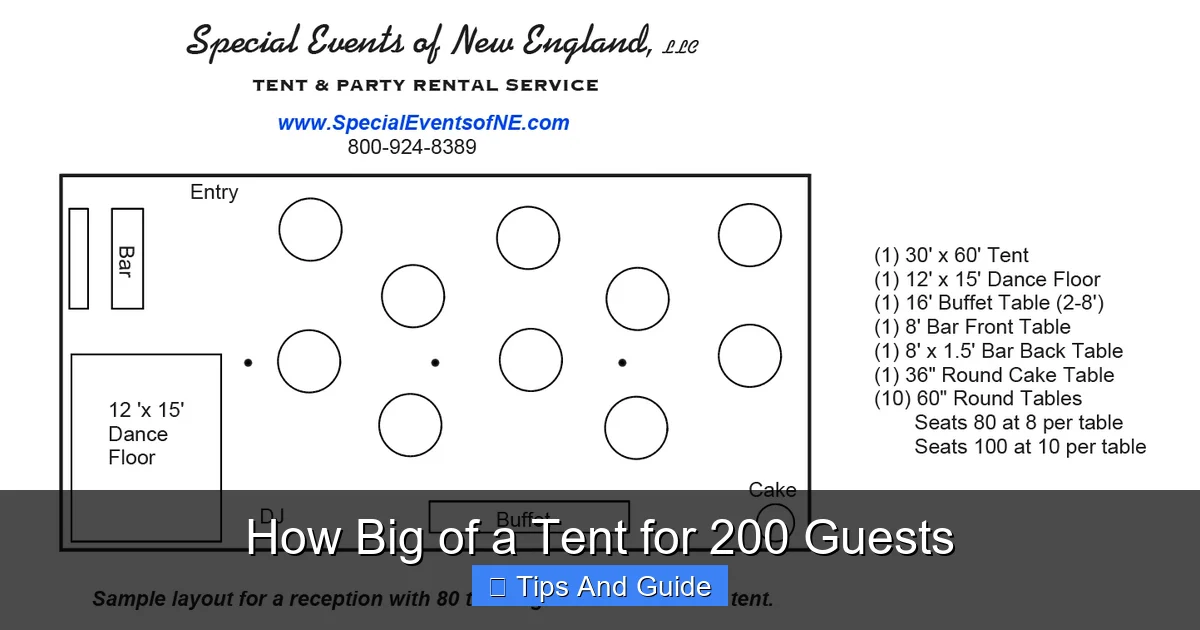
This is a common setup for weddings and banquets. Round tables are elegant but take up more space than rectangular ones. A standard 8-person round table requires about 80-100 sq ft, including chairs and aisle space.
* Calculation: 200 guests / 8 guests/table = 25 tables.
* Space per table: 25 tables * 100 sq ft/table = 2500 sq ft.
* Tent Recommendation: You’ll need a tent of at least **50′ x 50′ (2500 sq ft)**. A **50′ x 60′ (3000 sq ft)** tent offers more comfortable circulation and space for a head table or buffet.
Practical Tip: If using 10-person round tables, you’ll need fewer tables (20) but slightly more space per table, potentially bringing your total closer to 2000-2400 sq ft, but the 50’x50′ remains a good minimum.
#### Scenario C: Seated Dinner with Banquet Tables
Rectangular banquet tables (often seating 8-10 guests) are more space-efficient for larger groups. A 6-foot banquet table (seating 6-8) might use around 60-70 sq ft including chairs and aisles.
* Calculation (assuming 8 guests per table and 70 sq ft/table): 200 guests / 8 guests/table = 25 tables.
* Space per table: 25 tables * 70 sq ft/table = 1750 sq ft.
* Tent Recommendation: This calculation suggests a smaller tent than round tables, potentially **40′ x 50′ (2000 sq ft)**. However, you need to consider additional space.
Practical Tip: This calculation is for seating only. You still need space for catering, dancing, and guest movement.
#### Scenario D: Theater Style Seating (Presentations/Ceremonies)
If your event involves a speaker, awards ceremony, or presentation, theater-style seating is efficient.
* Calculation: 200 guests * 8 sq ft/guest = 1600 sq ft.
* Tent Recommendation: Similar to a standing reception, a **40′ x 40′ (1600 sq ft)** tent might work. However, you’ll need extra space for a stage or presentation area.
Practical Tip: Always add at least 100-200 sq ft for a stage or speaking area.
### Step 2: Factor in Additional Space Requirements
This is where the real complexity lies for a 200-guest event. You rarely just need space for seating.
#### Catering and Bar Area
Food and drink are central to most events. This requires dedicated space.
* Buffet Lines: Allow at least 10-15 feet for a buffet line, depending on how many stations you have. For 200 guests, you might need multiple buffet stations to avoid long queues.
* Catering Prep/Staging Area: Caterers often need a separate space behind the buffet or bar to prepare, plate, and stage food. This can be an additional 100-300 sq ft.
* Bar: A bar typically needs 10-15 feet of counter space plus room for the bartender and guests to order.
* Total Catering/Bar Space: Estimate at least **200-500 sq ft** for these needs, depending on the complexity of your service.
#### Dance Floor and Entertainment Area
If you plan on having a DJ, band, or simply want space for dancing, this needs to be factored in.
* Dance Floor: A good rule of thumb is 3-5 sq ft per person dancing. For 200 guests, that’s 600-1000 sq ft for a truly spacious dance floor. However, not everyone dances at once. A 15’x15′ (225 sq ft) or 20’x20′ (400 sq ft) area is often sufficient for a 200-person event to allow for a good number of people to dance.
* Stage/DJ Booth: Allocate space for performers or a DJ setup (100-200 sq ft).
* Total Entertainment Space: Estimate **300-800 sq ft** for dancing and entertainment.
#### Circulation and Guest Flow
This is often overlooked but vital for guest comfort. Guests need to move between tables, the bar, restrooms, and any other activity areas.
* Aisle Widths: Main aisles should be at least 4-5 feet wide. Smaller aisles between tables can be 2-3 feet.
* Buffer Zones: Leave some open space around the perimeter of the tent and between key areas.
#### Other Areas to Consider
* Gift Table: 50-100 sq ft.
* Photo Booth: 100-150 sq ft.
* Coat Check: 50-100 sq ft.
* Restrooms: While usually external, ensure easy access.
* Aisle for entry/exit: Allow clear pathways.
### Step 3: Combine Your Calculations and Add a Buffer
Now, let’s put it all together. Let’s take a common scenario: a seated dinner with 8-person round tables and a desire for a dance floor.
* Seating (200 guests at 8-person tables): 25 tables * 100 sq ft/table = 2500 sq ft.
* Catering & Bar: Let’s estimate 400 sq ft for buffet, bar, and staging.
* Dance Floor: Let’s allocate 400 sq ft for a good-sized dance floor.
* Circulation/Buffer: Add at least 10-15% for comfortable movement and less cramped feel. 10% of 3300 sq ft = 330 sq ft.
* Total Estimated Space: 2500 + 400 + 400 + 330 = **3630 sq ft**.
This suggests a tent in the **60′ x 60′ (3600 sq ft)** range, or perhaps a **50′ x 80′ (4000 sq ft)** tent for a more spacious feel.
Key Insight: For 200 guests, you are looking at a minimum of **2500-3000 sq ft** for a seated dinner, and potentially **3500-4000+ sq ft** when accounting for all activities and comfortable circulation.
## Common Tent Sizes and How They Fit 200 Guests
Tent sizes are usually listed in feet by feet (length x width). Here are some common sizes and their approximate capacities for different event types:
### Large Frame Tents (Generally More Versatile)
* 40′ x 80′ (3200 sq ft): This could work for a seated dinner with minimal extras, or a cocktail reception with a dance floor. It might feel a bit tight for a full banquet setup for 200.
* 40′ x 100′ (4000 sq ft): A very good option for 200 guests, offering ample space for seating, catering, and a dance floor. This size provides good flexibility.
* 50′ x 70′ (3500 sq ft): Another excellent choice, especially if you prefer a squarer layout. It balances seating and amenity space well for 200 people.
* 50′ x 80′ (4000 sq ft): This is a comfortable size, allowing for a generous setup with plenty of room for guests to mingle and enjoy themselves.
* 60′ x 60′ (3600 sq ft): A strong contender, offering a good square footprint that can be easily arranged.
* 60′ x 80′ (4800 sq ft): This size offers a luxurious amount of space for 200 guests, allowing for multiple zones (dining, lounge, dance floor, etc.) without feeling crowded.
### Pole Tents (Often More Economical, but Require Center Poles)
Pole tents can be slightly more space-efficient for seating due to their design but the center poles can affect layout.
* 40′ x 100′ (4000 sq ft): Similar to frame tents, this size is generally suitable.
* 50′ x 80′ (4000 sq ft): A good fit.
* 60′ x 70′ (4200 sq ft): A comfortable option.
## Other Crucial Factors to Consider
Beyond raw square footage, several other elements influence your tent choice.
### Tent Style and Structure
* Frame Tents: These are free-standing and don’t require interior poles, offering maximum open space and layout flexibility. This is often preferred for events with 200 guests where clear sightlines and ease of movement are paramount.
* Pole Tents: These rely on tension and stakes, often using a central pole or multiple poles for support. They can be more cost-effective but the poles can obstruct views and layouts.
* Clear Span Tents: These are engineered tents that offer wide, unobstructed interiors without internal poles, ideal for larger events requiring significant open space.
### Height and Headroom
Ensure the tent has sufficient height for your needs. You’ll want enough headroom for guests to feel comfortable, especially if you have taller guests or are planning activities like dancing. Standard heights are usually sufficient, but it’s worth confirming.
### Flooring
For 200 guests, especially for a seated dinner or if the ground is uneven, consider flooring. This adds to the overall cost but significantly improves comfort and aesthetics. Flooring will also impact the total space needed as it often sits slightly under the tent’s edge.
### Lighting and Ambiance
Lighting is crucial for setting the mood. Make sure the tent you choose can accommodate your lighting plan, whether it’s chandeliers, string lights, or functional task lighting. For a 200-guest event, good lighting is non-negotiable. You might also be interested in the best camping lights for tent for inspiration on how to illuminate a space.
### Climate Control
Depending on the season and location, you might need heating or air conditioning. Ensure the tent can accommodate these systems and that they are properly sized for the volume of air in the tent. For instance, a best camping AC unit for tent might be a consideration for smaller setups, but for a 200-guest event, professional HVAC is typically required.
### Site Layout and Access
* Delivery and Setup: Can large tent components be delivered to your site? Is there enough space for setup crew and equipment?
* Guest Access: How will guests enter and exit the tent? Is there a clear, accessible path?
* Restroom Access: Ensure adequate and accessible restroom facilities are available nearby.
* Parking: Sufficient parking for 200 guests is a must.
## Troubleshooting Common Tent Sizing Issues for 200 Guests
* **”My calculations say X, but the rental company says Y is needed.”** Trust the professionals! They have experience with various events and tent types. They will factor in all the nuances you might miss.
* **”The tent feels too crowded.”** This is usually due to underestimating space for circulation, catering, or activities. It’s always better to have a bit too much space than not enough. A tent that feels too small can make guests uncomfortable and hinder the event’s flow.
* **”I have a lot of open space, can I get a smaller tent?”** While you might have ample outdoor space, the tent’s interior is what matters for guest experience. Don’t compromise on the tent’s interior dimensions for the sake of the surrounding area.
## Final Recommendations for a 200-Guest Tent
For a seated dinner event with 200 guests, including a dance floor and catering area, a tent of **3500-4000 square feet** is a very safe and comfortable bet.
* Ideal Tent Sizes:
* 50′ x 70′ (3500 sq ft)
* 50′ x 80′ (4000 sq ft)
* 60′ x 60′ (3600 sq ft)
* 40′ x 100′ (4000 sq ft)
If your event is more of a standing cocktail reception with limited seating, you might be able to get away with a slightly smaller tent, around **2000-2500 sq ft**, but always add space for bars and mingling areas.
Always discuss your specific event needs, including the types of tables, chairs, serving styles, and any entertainment, with your tent rental company. They are the experts and can provide tailored advice based on their inventory and extensive experience.
## Conclusion
Choosing the right tent size for 200 guests is a critical step in event planning. It’s more than just a number; it’s about creating an atmosphere of comfort, flow, and enjoyment for everyone attending. By carefully considering your event’s style, seating arrangements, catering needs, and entertainment, you can accurately estimate the space required. Remember to factor in essential elements like circulation, buffer zones, and potentially specialized areas like dance floors or stages. When in doubt, always err on the side of slightly more space. A well-chosen tent will elevate your 200-guest event from good to unforgettable.
- Guest Count is Paramount: Always start with your exact guest count of 200 people to determine the minimum space required.
- Activity Space is Crucial: Consider what activities will take place inside the tent, such as dining, dancing, or presentations, as each requires different amounts of space.
- Seating Arrangements Matter: The type of seating (e.g., round tables, banquet tables, chairs only) significantly impacts the square footage needed per person.
- Catering and Bar Needs: Account for dedicated space for food service, buffet tables, and a bar area, which add to the overall tent size requirements.
- Circulation and Comfort: Ensure ample room for guests to move around freely, access facilities, and avoid feeling cramped, especially for a larger group of 200.
- Tent Style and Shape: Different tent styles (e.g., pole tents, frame tents) and shapes offer varying layouts and space utilization, influencing the final size needed.
- Factor in Extras: Don’t forget to allocate space for a dance floor, stage, DJ booth, photo booth, or any other special features your event might include.